Cybersecurity Lead Generation: What Works in 2026
- Brand Visibility Before the Buying Cycle: 95% of purchases come from the Day One shortlist. If your brand isn’t known before evaluation begins, you’re not on the list.
- AI Search Is Now the Top Shortlist Influence: 94% of buyers used LLMs during their buying process, and GenAI chatbots are now the #1 external source influencing vendor shortlists.
- Buyers Self-Serve First, Talk to Sales Later: 79% of buyers initiate first contact themselves. Your content and AI search presence need to do the selling before your team enters the picture.
- Proof Beats Claims Every Time: 56% of buyers talk to a product user before purchasing. Case studies, peer reviews, and compliance certifications outperform marketing claims at every stage.
- Precision Over Volume: Shortlists have shrunk to two to three vendors, down from four to seven in 2023. ABM must build preference before the Selection Phase begins — not during it.
- SEO and GEO Work Together: Structure content for both Google rankings and AI engine citations. Leads from LLMs convert at 3x the rate of traditional search leads.
The average data breach now costs organizations $4.44 million globally and $10.22 million in the United States — both record highs, according to IBM’s Cost of a Data Breach Report 2025.
Yet despite surging demand for cybersecurity solutions, marketers in the space still struggle to generate high-quality leads consistently.
Strategies that worked just a few years ago no longer resonate with today’s cybersecurity buyers. Potential customers thoroughly research solutions online, prioritize peer reviews, and independently verify vendor claims. Often, they delay direct sales interaction until late in their buying process, making traditional outreach ineffective.
Tom Shapiro, author of Rethink Lead Generation and CEO & founder of Stratabeat, stresses the importance of innovative, strategic approaches to engage modern buyers. In today’s crowded market, cybersecurity companies must clearly articulate their unique value and demonstrate expertise that directly addresses evolving cyber threats.
If your cybersecurity firm struggles to consistently convert potential leads into SQLs and loyal, long-term customers, use this guide as your blueprint. You’ll find practical strategies to reshape your approach to cybersecurity B2B lead generation.
Partnering with a specialized cybersecurity marketing agency gives you access to strategic expertise and proven methodologies built specifically for this market.
Key Challenges for CMOs and Marketing Teams
Cybersecurity marketers must navigate significant industry-specific hurdles to engage potential customers and generate high-quality leads.
Navigating Industry Competition
Cybersecurity is a fiercely competitive market, saturated by startups and established legacy companies. The window to influence a purchase decision is narrower than most marketers realize — and it closes earlier than most marketing teams act.
According to 6sense’s 2025 B2B Buyer Experience Report, 95% of purchases come from the Day One shortlist — the vendors buyers already have in mind before active evaluation begins. Eighty percent of deals are won by the vendor buyers contact first, and that first contact reflects existing preference, not persuasion. Buyers arrive with deeply formed vendor preferences built across an average of 8–9 prior purchase journeys in a given category.
TrustRadius data reinforces this further: 78% of B2B buyers shortlisted products they had already heard of before starting research — rising to 86% among enterprise buyers. And 71% ultimately purchased their first-choice product from that shortlist.
The implication is direct: if your brand isn’t present before a buying cycle starts, you’re likely not on the shortlist at all.
Why Brand Visibility Matters
| Finding | Stat |
|---|---|
| Purchases from the Day One shortlist | 95% |
| Deals won by the first vendor contacted | 80% |
| Buyers who shortlisted brands they already knew | 78% (86% enterprise) |
| Bought their first-choice product | 71% |
| Switched from preferred vendor after seller engagement | ~20% |
Now’s the time for you to create content that moves beyond vague statements such as “industry-leading solutions.” Build a value proposition grounded in measurable results, proprietary methodologies, and proof points directly relevant to your ideal customers — then carry that through every security-focused messaging touchpoint, from your website to your B2B marketing strategies and outbound campaigns.
Cybersecurity Buyer Journeys Are Evolving
The cybersecurity buying process now involves multiple decision-makers, each requiring tailored messaging. The Forrester B2B Buying Group Journey Map illustrates how stakeholder roles shift across the Discover, Evaluate, and Commit phases — with different personas carrying influence at each stage.
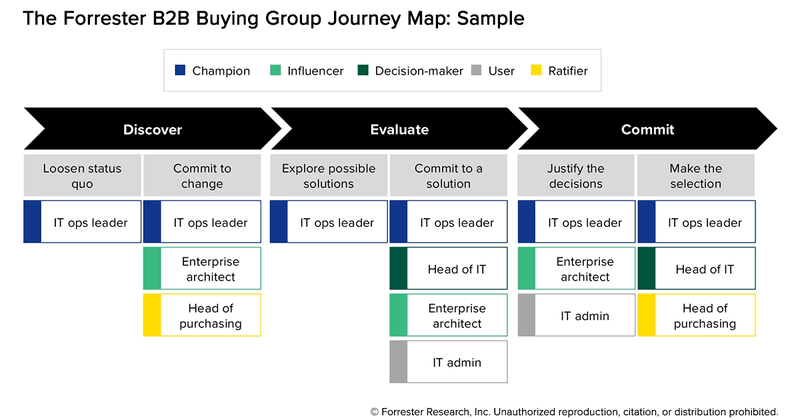
- Technical stakeholders in IT and information security require detailed technical documentation, transparent security specifications, and integration guidelines to assess solutions against evolving threats in their specific security environment.
- Executives and Procurement teams prioritize strategic alignment, business impact analyses, detailed case studies, and documented ROI to confidently select cybersecurity solutions and security products that serve their organization’s needs.
- Security Leaders — CISOs, VPs of Security, and Security Architects — increasingly drive or heavily influence vendor selection, bringing their own evaluation criteria around risk reduction, compliance, and operational fit.
The composition of buying committees is also shifting. G2 reports that five-to-eight person groups dropped by 11% year-over-year, while smaller trios and quartets are on the rise.
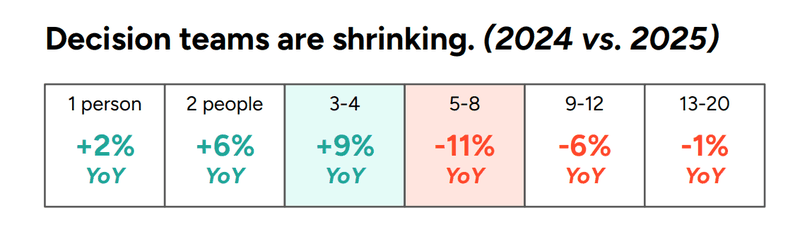
Your content now needs to reach fewer people, but each one carries more weight.
Add to this the AI mandate: 89% of buyers purchased solutions that included AI features (93% in software specifically), and 62% were mandated or strongly encouraged to select AI-enabled solutions. Nearly three in four companies also now impose stricter evaluation requirements for AI-powered software compared to non-AI solutions.
Buying cycles compressed from 11.3 months to 10.1 months year-over-year. Your personas and messaging need to reflect both the shorter timeline and the AI-readiness questions buyers now carry into every stage of the customer journey.
Crafting precise buyer personas enables targeted content creation that resonates with your cybersecurity prospects. Build each buyer profile around these inputs:
- Interview and survey existing and prospective buyers to surface actual customer needs, not assumed ones.
- Analyze CRM and intent data to discover attributes, needs, and behaviors.
- Define personas — job titles, responsibilities, cybersecurity pain points, decision criteria, content preferences, and key buying influencers.
Rise of Digital Self-Service
Most cybersecurity buyers conduct the majority of their journey independently before engaging any vendor. The Selection Phase now occupies roughly 60% of the buying cycle and 79% of buyers initiated first contact with vendors themselves.
The shift is accelerating. G2 reports that 79% of B2B software buyers say AI search engines have changed how they conduct research, and 62% now prefer contacting a sales rep only at the evaluation or decision stage.

What’s notable: 94% of buyers used LLMs during their buying process, yet LLM usage did not reduce direct vendor interactions. GenAI chatbots ranked as the top external source influencing vendor shortlists at 17.1%, ahead of software review sites and vendor websites.

Self-service and human interaction aren’t competing. Buyers want both, on their terms — and they’re doing their homework across multiple digital channels before your sales team ever enters the picture.
Meet buyer expectations with robust digital self-service tools:
- AI-driven chatbots that instantly address buyer queries and concerns related to cyber threats.
- Interactive demos offering personalized experiences of your solutions.
- ROI calculators demonstrating value, tailored to the cybersecurity buyer’s unique security environment.
- Security audit tools and assessment surveys that help prospects quantify their current exposure — and connect that gap directly to your solution.
- Threat reports and original research that buyers can reference during independent evaluation, positioning your brand as an authoritative source before any sales conversation begins.
If your team needs support building out both the self-service infrastructure and the AI search visibility that drives traffic to it, working with a GEO agency experienced in B2B cybersecurity can accelerate results significantly.
How Cybersecurity Buyers Research Vendors
| Buyer Behavior | Data Point | Source |
|---|---|---|
| Use LLMs during buying process | 94% | G2 |
| Initiate first vendor contact themselves | 79% | 6sense |
| Say AI search changed how they research | 79% | G2 |
| Prefer sales contact only at evaluation/decision stage | 62% | G2 |
| GenAI chatbots as top shortlist influence | 17.1% (#1 external source) | G2 |
| Selection Phase share of buying cycle | ~60% | 6sense |

Demand for Transparency and Authenticity
Buyers in cybersecurity arrive with high skepticism and specific questions. Research shows that 58% of buyers engaged vendors earlier than they otherwise would have specifically to evaluate AI implementation, because vendor websites didn’t provide the clarity they needed. Another 62% brought specific AI-related questions to vendors covering capabilities, pricing, data storage, model training, and security.
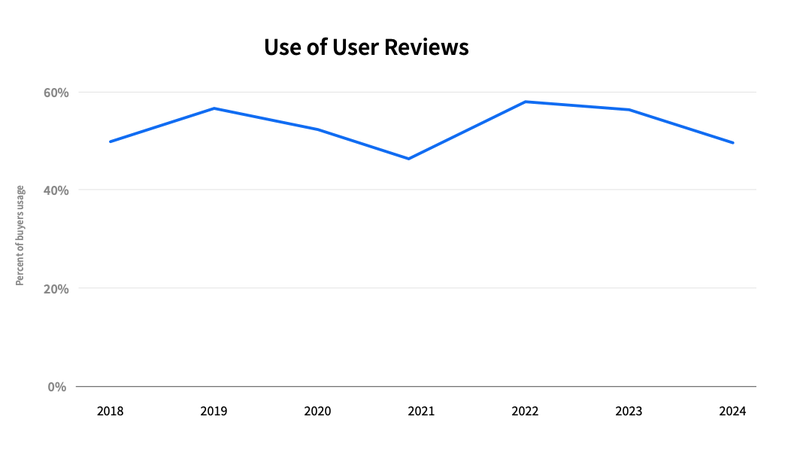
The trust gap is just as visible in how buyers validate decisions. According to TrustRadius, 56% of buyers had conversations with a product user before purchasing — rising to 71% among enterprise buyers — yet vendors estimated that figure at just 34%. User reviews remain among the top three resources consulted by technology buyers, while analysts report usage has hit a seven-year low of 16%.
In an environment where ransomware attacks, data breaches, and supply chain compromises are board-level concerns, buyers are not taking vendor claims at face value. They want documented proof.
Invest in:
- Verified case studies and customer success stories anchored to specific outcomes — reduced incident response time, measurable risk reduction, pipeline impact.
- Client testimonials and peer reviews on platforms like G2, Capterra, and TrustPilot.
- Third-party validations and compliance certifications — including SOC 2, ISO 27001, and other credentials your buyers’ procurement teams will specifically look for.
- Original threat reports and data-backed research that establish your team’s expertise before any sales conversation begins.
Budget and ROI Pressures
Economic uncertainty is reshaping how buyers select vendors. Nearly 70% of buyers said economic concerns shaped their vendor selection, pushing them toward known vendors and incumbents. 49% said uncertainty shortened their buying cycles, while 62% said it drove earlier seller engagement.

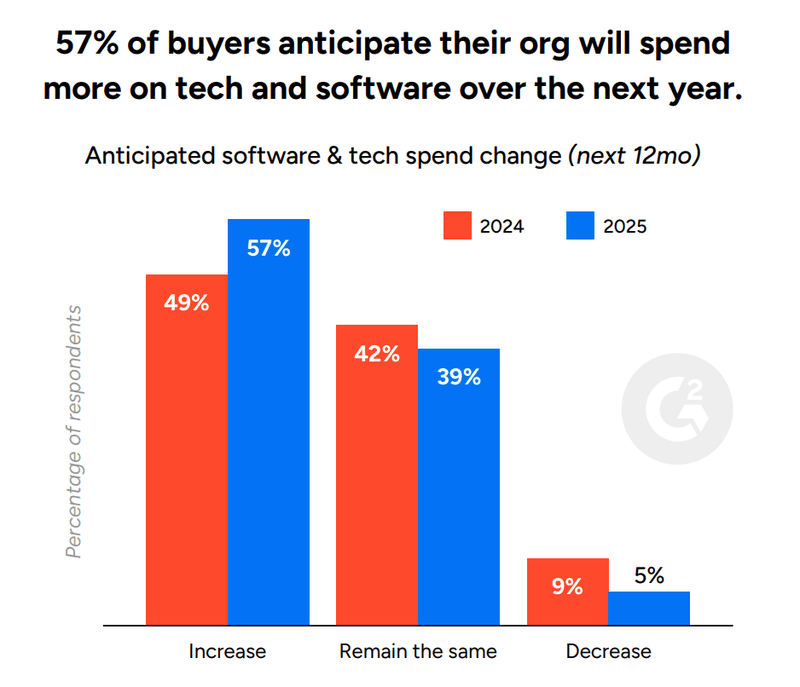
At the same time, 57% of buyers anticipate their organizations will increase tech and software spending over the next 12 months — up 8 percentage points year-over-year. And over two-thirds say they would pay a premium for AI functionality, but only if vendors clearly demonstrate its value.
That last point has direct implications for how you position and prove ROI. 47% of enterprise buyers said they wished calculating ROI were easier in order to get budget approved.
Optimize budget allocation by:
- Implementing attribution tools that measure campaign performance accurately.
- Continuously reallocating resources toward high-performing channels and campaigns, such as targeted ABM and personalized outreach.
Demonstrable ROI ties marketing investment to predictable revenue growth — and gives your champions the internal justification they need to move a purchase forward.
Common Mistakes Sabotaging Your Lead Generation
To maintain a steady stream of high-quality leads, avoid these common pitfalls.
Outdated Tactics
Many cybersecurity companies continue running tactics that no longer match how buyers actually buy:
- Cold Calling: Cybersecurity buyers rarely respond to unsolicited calls. The approach drains resources without reliably advancing the sales process.
- Generic Email Blasts: Sending impersonal messages to an unsegmented list consistently fails to engage sophisticated cybersecurity audiences. Invest in targeted, personalized campaigns that directly address buyers’ specific concerns.
- Static Product Demos: Buyers expect personalized experiences showing how your solution addresses their specific threat environment. Replace passive demonstrations with interactive, immersive experiences.
Outdated Tactics vs. What Works Now
| Outdated Tactic | Why It Fails | What to Do Instead |
|---|---|---|
| Cold calling | Buyers delay vendor contact until evaluation stage | ABM with intent data targeting |
| Generic email blasts | Sophisticated audiences ignore unsegmented outreach | Segmented, role-specific sequences |
| Static product demos | Buyers expect environment-specific proof | Interactive demos and self-service assessment tools |
| Gating everything | Buyers research independently; friction kills discovery | Ungated research for visibility, gated tools for high-intent capture |
Compliance & Data Privacy Best Practices
Data privacy regulations such as GDPR and CCPA present real operational constraints for cybersecurity marketers. To run compliant campaigns without sacrificing performance:
- Communicate data collection and privacy policies clearly across your website and marketing touchpoints.
- Obtain explicit, informed consent to protect your email list and CRM data.
- Use compliant marketing automation platforms such as HubSpot, Marketo, or Pardot to manage consent preferences consistently.
- Audit data management procedures regularly to maintain compliance and keep marketing and sales efforts running without interruption.
A privacy-first approach builds buyer trust and protects the long-term health of your pipeline.
Personalization: A Must-Have, Not Optional
Cybersecurity buyers expect personalized experiences at every stage of their journey. Generic or overly automated interactions reduce engagement and weaken pipeline quality.
The threat landscape makes this more urgent. According to IBM’s research, one in six breaches involved attackers using AI — including AI-generated phishing and deepfake impersonation. Buyers navigating that environment are not responding to mass outreach. They’re responding to vendors who demonstrate they understand the specific risks their organization faces.
Implement these practices:
- Segment your audience by industry, role, and buyer stage. Industry-specific whitepapers, assessments, and webinars consistently outperform broad content in engagement and conversion.
- Apply behavioral insights from session data, content engagement, and intent signals to identify where each website visitor is in their journey — and adjust messaging for your prospect accordingly.
- Use AI-powered outreach to scale personalization in initial touchpoints, while preserving human interaction for complex consultations and high-value accounts.
- Ground every personalized interaction in a clear understanding of customer needs at that specific stage — not just their job title or company size.
Misalignment Between Sales & Marketing Teams
Misalignment between cybersecurity sales and marketing teams directly degrades lead quality and slows pipeline velocity. When internal teams operate from different definitions of a qualified lead, opportunities fall through the cracks at every stage of the sales funnel.
Address it directly:
- Define shared KPIs — MQL-to-SQL conversion rates, pipeline velocity, and revenue contribution — so both teams are measuring success the same way.
- Develop formal Service-Level Agreements (SLAs) that outline responsibilities, timelines, and lead handoff processes between marketing, sales development, and closing teams.
- Use integrated CRM platforms (e.g., Salesforce, HubSpot) to give all internal teams visibility into the full sales funnel and minimize dropped opportunities.
Quantity Over Quality
Chasing lead volume in cybersecurity produces wasted budget and low conversion rates. The data makes the case for precision clearly.
According to the 2025 B2B Buyer Experience Report, 94% of buying groups ranked their shortlist in order of preference before engaging with any vendor. Only about 20% switched from their initially preferred vendor after engaging sellers. That means ABM must focus on getting into the consideration set early — before the Selection Phase begins — not on winning during vendor validation.
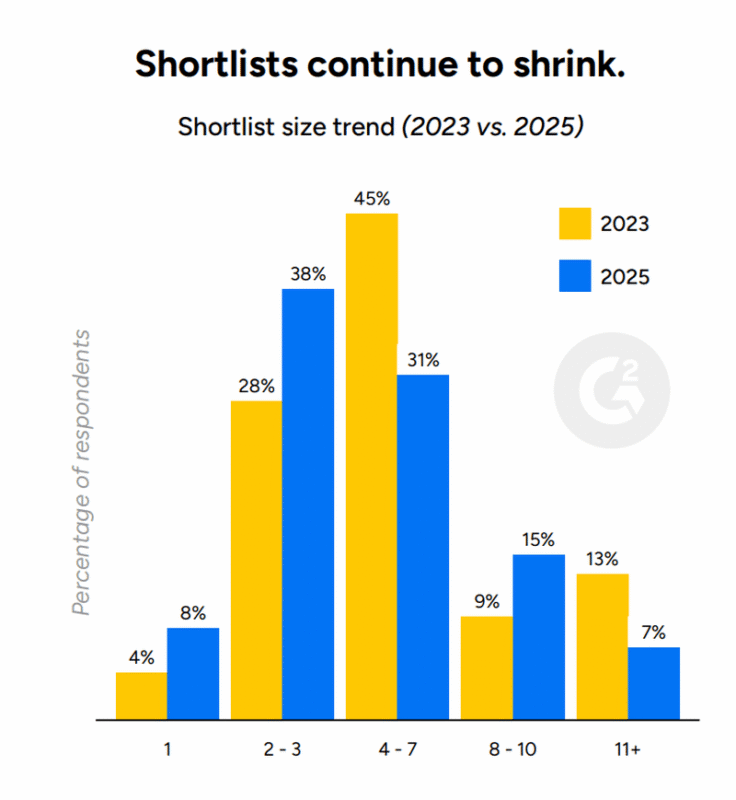
Vendor shortlists have also shrunk. Buyers now prefer narrowing to two to three vendors, down from four to seven in 2023.
Prioritize quality by:
- Deploying ABM with target account acceleration in mind — building preference and familiarity at key accounts before they enter active evaluation.
- Using predictive analytics and intent data to identify accounts showing readiness to act on pressing security concerns.
- Building qualification procedures that filter for fit and urgency, not just engagement volume.
- Identifying market entry opportunities through partner ecosystems — MSPs, resellers, and technology alliance partners who already have relationships inside your target accounts.
Lead Scoring & Qualification: Best Practices Checklist
A strong scoring strategy concentrates sales effort on the accounts most likely to close. Phishing was the most common initial attack vector in 2025, accounting for 16% of breaches at an average cost of $4.8 million per incident. Accounts with demonstrable security gaps and active threat exposure represent both high urgency and high intent — and should be weighted accordingly in your model.
Follow this checklist to tighten your qualification process:
- Build detailed customer profiles that define your ideal accounts by industry, company size, security maturity, compliance requirements, and technology environment — including whether they operate in high-risk verticals like financial services, healthcare, or critical infrastructure.
- Use data enrichment tools to fill gaps in your CRM records — firmographic data, technographic signals, and intent data that sharpen your understanding of each account before outreach begins.
- Score prospects based on behavioral signals: content engagement, security audit completions, webinar attendance, demo requests, and email interaction.
- Use predictive analytics to detect intent signals indicating readiness to buy, and concentrate resources on the strongest prospects.
- Set thresholds that automatically route Sales-qualified leads to your sales team, with clear rules for continued nurturing or disqualification at each stage of the sales funnel.
MQL vs. SQL in Cybersecurity
| MQL | SQL | |
|---|---|---|
| Definition | Engaged with marketing + fits ICP | Vetted for fit, urgency, and buying intent |
| Typical signals | Content downloads, webinars, assessments | Demo requests, security audit completion, pricing inquiries |
| Cybersecurity-specific filters | Industry, company size, compliance environment | Active threat exposure, compliance deadline pressure |
| Owner | Marketing | Sales |
How to Rethink and Revamp Your Cybersecurity Lead Generation Strategy
To attract potential clients and differentiate within the fiercely competitive cybersecurity sector, marketers must proactively innovate their approach to lead generation. Below are actionable strategies for driving sustainable growth, drawn from Tom Shapiro’s insights and current market data.
Cybersecurity Lead Generation Strategies Ranked
| Strategy | Funnel Stage | Best For | Time to Impact |
|---|---|---|---|
| SEO + GEO | Problem/Solution Aware | Sustained inbound visibility in Google and AI engines | 3–6 months |
| Original threat research | All stages | Authority, AI citations, PR | 2–4 months |
| ABM | Pre-evaluation | High-value target accounts | 1–3 months |
| Security assessment tools | Solution Aware | High-intent lead capture | 1–2 months |
| Referral/partner programs | Decision | Trust-driven verticals | 3–6 months |
| Webinars + niche communities | Problem Aware | Practitioner trust building | 1–2 months |
Prioritize Creativity and Strategic Innovation
Standard marketing practices in cybersecurity consistently produce indistinct messaging. The data confirms it: 53% of marketers say they struggle to differentiate their content in an AI-saturated market, and 52% believe AI makes content so easy to produce that it’s become less persuasive overall.
The response isn’t more content. It’s more distinctive content.
61% of marketers agree that expressing your brand’s point of view is a necessary component of a competitive AI strategy. In cybersecurity, where every vendor claims to be comprehensive, proactive, and trusted, a recognizable perspective is one of the few genuine differentiators left.
Evaluate your marketing initiatives against these criteria before committing resources:
- Implementation ease: Can this strategy reach your ideal customer profile quickly?
- Cost-effectiveness: Does the expected impact justify the investment?
- Revenue potential: Will this approach attract accounts worth winning long-term?
- ROI clarity: Can return on investment be measured clearly over time?
Adopt a Multi-Channel Approach
75% of marketers now use five or more distinct marketing channels. The channels generating the highest ROI:
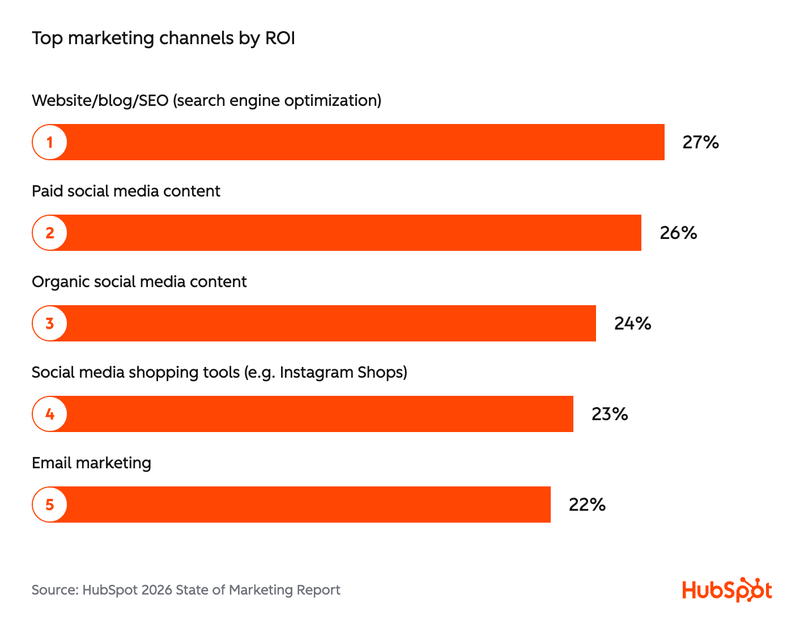
Notably, 94% of marketing teams diversified their channel mix in the past year — and four in 10 said the most impactful change was moving from broad platforms to niche communities. For cybersecurity marketing, where practitioner trust and peer validation carry outsized influence, that finding deserves attention.
Build your channel mix around these core areas:
- SEO and GEO: Drive sustained organic visibility in both traditional search and AI answer engines for buyers actively researching cybersecurity solutions.
- Content Marketing: Publish content that addresses the specific threat scenarios, compliance pressures, and operational challenges your ideal customers face.
- Organic and Paid Social: Build thought leadership visibility and reach key decision-makers through targeted campaigns on LinkedIn.
- Email Marketing: Nurture prospects with segmented, personalized content tied to their role and buyer stage.
- ABM: Concentrate customized outreach on your highest-priority target accounts.
- Interactive Digital Tools: Provide virtual demos and assessments that let buyers evaluate your solution on their terms.
- Niche Communities and Practitioner Networks: Participate where cybersecurity practitioners actually exchange information and form vendor opinions.
A fully integrated multi-channel approach delivers a cohesive buyer experience, enhancing conversion rates and consistently attracting high-value prospects.

Turn Your Website into a Conversion Engine
Your website is where intent either converts or evaporates. Tom Shapiro identifies ineffective CTAs as one of the most common — and most correctable — reasons cybersecurity companies fail to convert visitors into qualified leads.
One additional pressure point worth noting: 60% of marketers say that when high-intent visitors arrive from AI referral traffic, they need seamless purchasing experiences — such as chatbots — that match the ease of the platforms that referred them. Buyers arriving from LLMs are further along in their research. A friction-heavy website will lose them.
Apply these practices to improve conversion performance:
- Audit and replace underperforming CTAs: Use CRO software to track click behavior on each CTA. If “Contact Us” or “Contact Sales” generate minimal engagement, replace them. Don’t hold onto CTAs that aren’t working.
- Match CTAs to content context: Use “Book a Demo” on product-focused pages. Offer educational resources — reports, webinars, assessments — on top-of-funnel content. Context determines relevance.
- Cascade CTAs through blog posts: Introduce informational offers early, then shift toward higher-commitment offers — templates, case studies, demos — as readers move deeper into a post.
- Vary CTA formats: Test floating bars, pop-ups, and slide-ins to disrupt visual patterns and capture attention.
- Use specific, action-oriented language: “Download Your Free Cybersecurity Report” outperforms “Learn More” every time.
- Promote live events prominently: Webinar-focused CTAs consistently deliver strong engagement and help build your prospect database.
- Test continuously: Run A/B tests on messaging, design, and placement. Never treat a CTA as finished.
- Simplify lead capture forms: Shorter forms reduce friction. Ask only for what you need at that stage of the journey.

The Role of SEO and Content Marketing
SEO remains one of the highest-ROI marketing channels available — but what it takes to win is changing fast.
41% of marketers say updating their SEO strategy for AI-driven search is the top trend they’re currently acting on. The shift is visible in the data: 49% of marketers report that web traffic from traditional search has declined due to AI-generated answers — but 58% note that referral traffic from AI search engines carries significantly higher intent than traditional search traffic.
HubSpot’s own internal data adds context worth noting: while blog traffic has declined, leads from LLMs increased 1,850% and convert at three times the rate of traditional search leads. That’s a single company’s internal data point, not a universal benchmark — but directionally, it reinforces what Stratabeat is seeing across its client portfolio.
For cybersecurity marketers, the practical implications are:
- Technical SEO foundation: Optimize site performance, page speed, and crawlability to support both Google rankings and AI engine retrieval. If you’re evaluating outside support, look for a B2B SEO agency with demonstrated experience in SEO for cybersecurity — the competitive dynamics and buyer intent patterns in this space are distinct from general B2B markets. When researching options, the best B2B SEO agencies will show you category-specific case studies, not just domain authority metrics.
- Conversational and intent-driven content: Structure content around the specific, multi-layered questions your buyers are asking in AI search — not just the keywords they typed two years ago.
- Topical authority: Build content clusters that demonstrate deep expertise across your core solution areas, not just individual high-traffic pages.
- Generative engine optimization: GEO means structuring content with key takeaways, FAQs, comparison tables, and summary blocks that AI search engines can parse and cite directly. For cybersecurity brands, GEO visibility during the research phase is where shortlist formation increasingly begins.
- Threat reports and original research: Data-backed content that establishes expertise, earns citations in AI-generated answers, and gives buyers something substantive to reference during independent evaluation.
- Security assessment surveys: Gated tools that capture high-intent leads while delivering immediate, personalized value to prospects quantifying their own risk exposure.
- Content syndication: Distribute priority content through relevant cybersecurity publications, industry newsletters, and partner channels to extend reach beyond your owned audience and build the third-party mentions that reinforce both SEO authority and AI engine trust signals.
A strong B2B SEO and content program compounds over time — building topical authority, AI citation, and pipeline contribution simultaneously. If internal bandwidth is the constraint, a content marketing agency with cybersecurity expertise can own production and strategy while your team stays focused on demand generation execution.

Strategic Personalization
93% of marketers report that personalization improves leads or purchases. Yet only 13% of teams hyper-personalize based on data or lookalike audiences, and only 14% segment or personalize at least half of their content.
That gap is a competitive opening. Channels that support the most personalization rank almost identically to channels that generate the highest ROI — suggesting that personalization capability and channel performance are directly linked.
In cybersecurity, where buyers are navigating AI-driven threats, compliance mandates, and internal budget scrutiny simultaneously, generic outreach has a measurably short shelf life.
Implement these practices:
- Segment your audience by industry, role, and buyer stage. Industry-specific whitepapers, threat assessments, and targeted webinars consistently outperform broad content in engagement and conversion.
- Use AI to scale personalization in initial outreach, while preserving human touchpoints for complex consultations and high-value accounts.
- Apply behavioral and intent data to adjust messaging in real time, reaching buyers with relevant content at the moment it matters.
Effective ABM Strategies for High-Quality Cybersecurity Leads
ABM in cybersecurity is a pre-emption strategy. The goal is to build preference before formal evaluation begins.
Execute ABM with precision:
- Identify target accounts using company size, security maturity, threat exposure, and solution fit. Prioritize accounts operating in your core categories — whether that’s Network Security, Endpoint Protection, Cloud Security, Threat Detection & Response, Identity & Access Management, Application Security, Managed Security Services, or SIEM & SOAR Platforms. Accounts with known gaps in these areas carry built-in urgency.
- Use data enrichment to build a complete picture of each account — technographic data showing which security products they currently run, firmographic signals indicating growth or compliance pressure, and intent data flagging active research behavior.
- Build personalized content and messaging that speaks directly to each account’s known pain points, compliance environment, and business objectives.
- Use tools like LinkedIn Sales Navigator and ZoomInfo to reach decision-makers with targeted ads, personalized email sequences, and dedicated landing pages built for their context.
Accelerating Growth Through Referrals and Strategic Partnerships
Strategic partnerships and referrals extend your reach into buyer networks your direct marketing won’t penetrate:
- Partner Ecosystems: Build formal partnerships with Managed Security Services providers, MSPs, cybersecurity advisory firms, and complementary technology vendors. These relationships open market entry opportunities into new verticals and geographies while strengthening brand credibility through trusted association.
- Customer Referral Programs: Structure programs that reward satisfied clients for active advocacy. In cybersecurity, a peer recommendation from a trusted practitioner carries far more weight than any vendor-produced asset.
Measurement & Analytics: Tools for Actionable Insights
Measuring marketing performance is the foundation of sustained investment and optimization. Use these tools to track and refine your approach:
- Google Analytics 4 (GA4): Real-time analytics with predictive features to identify which content and channels are attracting your highest-quality visitors.
- Adobe Analytics: Detailed insight into user behavior, campaign engagement, and cross-channel performance.
- Google Search Console (GSC): Organic search data to monitor rankings, identify keyword opportunities, and track search visibility over time.
- Mouseflow: Behavioral analytics and session recordings to surface friction points and identify where visitors are dropping off before converting.
Consistent measurement keeps budget allocation tied to performance and gives you the data to defend and grow your marketing investment over time.
The Future of Cybersecurity Lead Generation
Frequently Asked Questions
Independently and extensively. The Selection Phase now occupies roughly 60% of the buying cycle, 79% of buyers initiate first contact themselves, and 94% use LLMs during their research. Buyers consult AI search engines, peer reviews, user conversations, and analyst alternatives long before a sales rep enters the picture — and most prefer to delay vendor contact until the evaluation or decision stage.
Documented proof over marketing claims: measurable risk reduction, compliance fit (SOC 2, ISO 27001), operational compatibility with their existing stack, and validation from peers who actually use the product. CISOs and security architects increasingly drive vendor selection directly, bringing their own evaluation criteria into the buying committee.
Generative engine optimization (GEO) is the practice of earning visibility in AI search engines like ChatGPT, Claude, Gemini, and Perplexity. For cybersecurity brands, it means structuring content with conversational queries, FAQs, key takeaways, and comparison tables that AI engines can parse and cite — because shortlist formation increasingly happens inside AI answers, before buyers ever reach your website.
Through a combination of strong technical foundations (clean, crawlable HTML; fast page speed), structured and conversational content, industry-specific pages, FAQs, original research, and offsite authority signals like reviews and third-party mentions. AI engines cite every page type — homepages, product pages, industry pages, and blog posts alike — so your own domain can become the most cited source for your category’s queries.
Content that buyers reference during independent evaluation: original threat research, “best of” comparison content, industry-specific resources, detailed case studies with quantified outcomes, security assessments, and interactive tools like ROI calculators. Generic thought leadership underperforms; content tied to specific threat scenarios and compliance pressures converts.
Define shared KPIs (MQL-to-SQL conversion, pipeline velocity, revenue contribution), formalize lead handoff in SLAs, and use an integrated CRM so both teams see the full funnel. Also train sales to ask “How did you hear about us?” and log answers in the CRM — it’s one of the only reliable attribution signals for AI search-influenced pipeline.
An MQL has engaged with your marketing (content downloads, webinars, assessments) and fits your ICP; an SQL has been vetted against fit, urgency, and buying intent — often signaled by behaviors like demo requests or completing a security audit tool. In cybersecurity, the strongest MQL-to-SQL filters weight active threat exposure and compliance pressure, not just engagement volume.
Related Blog Posts