The 10 Best GEO Agencies in 2026

Let’s get the obvious out of the way: this list is published by Stratabeat, and Stratabeat is ranked #1 on it. You have a right to be skeptical. We would be.
So here’s the deal we’re making with you. We’re transparently showing our criteria up front for the best GEO agencies, applying them to every agency on this list (including ourselves) and citing evidence you can verify independently: published case studies, Clutch reviews, and public thought leadership. If we don’t earn the top spot by those standards, you’ll be able to see it.
The four criteria, in the priority order that matters when you’re a VP of Marketing or CMO making a real buying decision:
- GEO-specific Case Studies — Not general SEO wins rebranded as AI optimization. Did the agency publish documented results showing what they did and what happened in generative search environments?
- Proof of Leads Generated from GEO — Visibility is nice. Leads and pipeline are what marketing leaders are accountable for. Did the work drive qualified inbound demand and measurable business outcomes?
- Clutch Reviews — Third-party, verified client satisfaction. How consistently do clients report getting what was promised?
- Thought Leadership and Transparency about How GEO Gets Done — Not just claiming to do GEO, but publishing the methodology, citing verifiable evidence, and documenting which specific tactics drove measurable results. The agencies that publish how GEO gets done demonstrate the kind of transparency that also shows up in how they run client work.
Judge the evidence, ask the agencies on this list our five questions at the bottom, and decide for yourself.
What Is Generative Engine Optimization (GEO)?
How We Evaluated The Agencies
Quick Comparison: All 10 GEO Agencies at a Glance
#1 Stratabeat
Best For: B2B SaaS and technology companies that want GEO services tied directly to leads and pipeline
Stratabeat earns the top position on this list for one reason above all others: they bring receipts. Sixty-one percent (61%) of Stratabeat’s GEO clients are the most mentioned brand in the LLMs in their categories across a set of custom non-branded prompts. While most agencies describe GEO in marketing language, Stratabeat publishes specific case studies — with real metrics, real timelines, and explicit AI visibility results — across multiple clients and industries. They are also one of the agencies on this list whose leadership team is most actively publishing how GEO gets done based on multiple data studies and Stratabeat’s own client results.
| Headquarters | Boston, MA (with staff throughout the U.S., Canada, and Mexico) |
| Clutch | ⭐⭐⭐⭐⭐ 5.0 (12 reviews) |
| Notable Clients | WellSaid, Masttro, TreviPay, LBMC, Provenir, Zoovu, LLC Attorney, Freshworks, Appfolio, Intel, GE |
| Services | GEO/AEO, SEO, Content Strategy, CRO, Authority Building, Analytics, Web Design |
| Best For | B2B SaaS, fintech, cybersecurity, martech, and other technology companies |
| Pricing | Starting at $6,000/month — see pricing |
Thought Leadership: Tom Shapiro & Alexis Trammell
Stratabeat’s competitive edge on this criterion is its leadership team. CEO Tom Shapiro and Chief Growth Officer Alexis Trammell are among the most active practitioners publishing content and speaking at industry events about how GEO actually works — not just that it matters. Their content goes beyond high-level takes: they share actual data studies, data deep-dives, methodology breakdowns, real-world case studies, and LLM visibility strategies. In a field crowded with agencies that added “AI” to their SEO service pages and called it GEO, Stratabeat’s willingness to show actual work and actual data is a differentiator.
GEO Case Studies
Stratabeat has published multiple GEO-specific case studies connecting AI optimization work to qualified leads, pipeline, and sales opportunities. A summary of four:
WellSaid (AI Voice SaaS) — Within 90 Days
- 209% increase in ChatGPT brand mentions
- 1,076% increase in non-branded organic traffic
- Higher traffic at a 88.2% lower monthly cost vs. paid search
- Record number of enterprise leads
- #1 most cited brand in AI Search in their category
WellSaid was over-reliant on paid channels when they partnered with Stratabeat. The strategy combined technical optimization, GEO/AEO work, entity signals strengthening, and CRO. Within 90 days, organic search was outperforming paid at a fraction of the cost — and AI visibility was driving Fortune 500 enterprise leads.
Masttro (Wealth Management and Family Office Software) — Within 6 Months
- +209.1% jump in monthly AI search-driven traffic
- +707.0% increase in monthly non-branded search traffic
- +544.4% growth in monthly booked sales meetings
- #1 most cited brand in AI Search in their category
When Masttro came to Stratabeat, there was low visibility in the LLMs as well as in Google. We developed content strategies that were explicitly optimized for AI engines alongside traditional search — with content architecture, entity optimization, and semantic structure all tuned for how generative AI models retrieve and surface answers.
LBMC (B2B Financial Services Company) — 3 Months
- +138.1% QoQ growth in sales opportunities
- 3.4x more monthly SQOs in 3rd month vs. average of nine previous months
- Record quarterly leads within six months
- #1 most recommended brand in AI Search in their category
- #1 most cited brand in AI Search in their category
A leading B2B accounting, tax, and advisory firm was experiencing declining organic visibility and inconsistent pipeline flow. Stratabeat implemented an integrated GEO, SEO, CRO, and content program. The result: their strongest quarter of sales opportunities on record, with more leads in the first three weeks of the quarter than in the entire quarter of the prior year.
LLC Attorney (Business Formation Platform) — 13 Months
- +351.1% increase in organic traffic
- +417.4% increase in LLM referral traffic
- +241.8% increase in page-one non-branded rankings
- 100,000+ new companies formed via the platform
Stratabeat rebuilt LLC Attorney’s digital presence from the ground up — redesigning the website, developing brand strategy, building a comprehensive content architecture with question-driven content creation optimized for both Google and AI-powered answer engines, implementing JSON-LD structured data, and developing location and industry pages that achieved thousands of page-one rankings and a 417.4% increase in LLM-sourced traffic.
Across these four case studies, the pattern is consistent: Stratabeat integrates GEO with SEO, CRO, and content strategy as a unified system — not as a standalone tactic — and measures success in leads and pipeline outcomes. That approach, combined with a 5.0 out of 5.0 Clutch score on this list as well as active thought leadership on GEO research and methodology, earns them the top position.
#2 Go Fish Digital
Best For: Companies that want a technically rigorous, patent-informed GEO partner
Go Fish Digital holds the #2 position because they published the most explicitly GEO-specific case study of any agency on this list — and it focused squarely on leads. While many agencies publish traffic wins and rebrand them as GEO success, Go Fish documented exactly how they executed a GEO strategy and what happened to leads as a result. That transparency is rare, and it mirrors the same standard of evidence they bring to client work.
| Headquarters | Raleigh, NC (with offices in Boston, DC, Phoenix, San Diego) |
| Clutch | ⭐ 5.0 (13 reviews) |
| Notable Clients | HP, Wayfair, Jelly Belly, T-Mobile, Southwest Gas, Joybird |
| Services | GEO, SEO, Paid Search, Content, Digital PR, ORM, Web Design |
| Best For | SaaS and DTC brands wanting data-science rigor and patent-based GEO strategy |
| Pricing | Custom — contact for quote |
GEO Case Study: 3x Lead Growth in 90 Days
- +43% AI referral traffic growth
- +83% AI conversion lift
- 25x higher conversion rate from AI leads vs. traditional search
- 3x lead growth in 90 days across four levers: prompt mapping, benchmarking, content, query fan-out expansion
Go Fish’s published GEO case study documented a 90-day campaign focused on AI search performance measurement. The four core levers: prompt mapping (identifying the specific questions buyers use when evaluating GEO agencies, including query fan-out variations), benchmarking with GA4 regex filters and log-file analysis, fact-dense cornerstone content engineered for LLM knowledge capture and statistical grounding, and query fan-out expansion (building pages around adjacent buyer prompts to capture citations across the full research journey). The result was a 43% increase in AI referral traffic, an 83% conversion lift from AI referrals, and leads from AI sources converting at 25x the rate of traditional search.
One detail worth noting: Go Fish ran this campaign on their own agency as the client, which means the results reflect their specific starting point — an already-established domain authority and existing external brand signals. They say so explicitly in the case study, noting that brands without that foundation may need to invest in reputation-building and authority signals before GEO content strategies can scale effectively.
Thought Leadership
Go Fish’s thought leadership is technically credible and consistent. The agency built Barracuda — a proprietary tool that evaluates pages against patent-derived signals for LLM optimization — and publishes how it works. Their published guides on GEO strategies and search mechanics for AI-powered search tools put them firmly in the practitioner tier. This combination of technical depth, transparent proprietary methodology, and published results places Go Fish near the top of our GEO agencies list.
#3 iPullRank
Best For: Enterprise organizations with complex technical SEO challenges

iPullRank ranks #3 on thought leadership alone — founder Mike King is arguably the most credentialed individual GEO practitioner in the United States right now, and the Relevance Engineering framework he developed has become one of the most widely cited methodologies in the field. The reason Go Fish edges them is case studies: iPullRank’s documented results are primarily enterprise SEO and organic relevance wins, while GEO-specific lead attribution is less explicitly published. But for VP/CMO-level buyers at large organizations, iPullRank’s depth of methodology and enterprise pedigree make them a top-three consideration.
| Headquarters | New York, NY |
| Clutch | Not yet reviewed |
| Notable Clients | SAP, American Express, HSBC, Microsoft, Citi, LG, Dropbox, General Mills |
| Services | GEO, Technical SEO, Relevance Engineering, Content Strategy, AI Content Programs |
| Best For | Enterprise brands with technically complex sites |
| Pricing | Custom — contact for quote |
Thought Leadership: Mike King
Mike King was named Search Engine Land’s 2025 Search Marketer of the Year and launched the inaugural SEO Week conference in New York City in 2025. He also published the AI Search Manual, a comprehensive guide to generative search optimization covering topics such as AI search architecture, query fan-out, passage-level retrieval, and performance measurement. iPullRank has produced extensive research on AI-powered search, including analyses of passage-level retrieval, latent intent modeling, and Google AI Overviews. The agency has also tracked the growth of AI Overviews, highlighting findings that coverage expanded from 6.49% of queries in January 2025 to 13.14% by March 2025. The manual’s “Content Collapse” chapter argues that the rapid growth of AI-generated content is reducing overall search index quality, with significant implications for GEO strategy.
iPullRank’s research argues that retrieval in AI-powered search operates at a passage level, with individual passages represented in vector space for retrieval. Their query fan-out and latent intent research, alongside their AI Overviews tracking study, have become widely cited references across the GEO field.
GEO Work
iPullRank’s Relevance Engineering framework maps AI retrieval mechanics — query fan-outs, passage retrieval, semantic structure, entity signals — to content engineering for how generative AI models actually cite sources. They’ve built an 8-step Generative AI Content Program for enterprise clients that covers goal and strategy review, AI integration mapping, content model and workflow development, prompt library construction, output QA testing, and ongoing prompt maintenance as generative AI tools evolve — with knowledge transfer built in so client teams can operate the system independently.
Their technical foundation work — JavaScript rendering analysis, site architecture for AI crawlability, schema precision — is cited in the industry as the gold standard for pre-content GEO work. Client results are documented at the organic and relevance level but GEO-specific lead attribution is less explicitly published than the agencies in the top two positions.
#4 First Page Sage
Best For: Professional services firms, enterprise SaaS, and high-trust B2B verticals
First Page Sage pioneered GEO as a named discipline in 2023, roughly 14 months after ChatGPT’s debut, and has published more original research on generative AI recommendation algorithms than any other agency. They earn the #4 slot for strong case study evidence, consistent presence in enterprise client work, and a founder (Evan Bailyn) who has been publishing GEO content since before most agencies had heard the term. The gap from the top three is a lack of Clutch reviews and less explicit connection between GEO work and lead outcomes in published case studies.
| Headquarters | San Francisco, CA |
| Clutch | Not yet reviewed |
| Notable Clients | Salesforce, Logitech, Verizon, Verisign, Nerdwallet, Cadence Design Systems |
| Services | GEO/AEO, SEO, Thought Leadership Content, B2B Blogging, Executive Branding |
| Best For | Professional services, medtech, manufacturing, enterprise SaaS, legal and financial services |
| Pricing | Starting at $12,000/month for full-service packages |
GEO Case Studies & Results
First Page Sage’s most cited case study is Cadence Design Systems, where a Hub & Spoke content model produced a 934% increase in total keyword rankings, record free trial requests, and reduced cost-per-conversion. For GEO specifically, their 2023 research study analyzing 11,128 queries across the top four AI platforms was the first comprehensive analysis of what causes generative search engines to recommend one brand over another — a piece of original research that has been cited widely across the industry. First Page Sage has worked with enterprise brands including Salesforce, Logitech, and Verizon and has published extensive GEO research and methodology focused on improving visibility in AI-generated search experiences.
Thought Leadership
Evan Bailyn publishes consistently on GEO strategy, algorithm research, and content methodology. Their GEO Strategy Guide and CAC benchmark study — based on 127 B2B companies over 18 months — are among the most-cited primary sources in the field. First Page Sage also ghostwrites approximately 80 content pieces annually for clients as part of their Thought Leadership SEO service, combining content creation with authority-building capabilities optimized for both Google and AI-powered answer engines. Their content leans more toward published research and editorial guidance than practitioner how-to transparency, which is a different flavor than Stratabeat or Go Fish, but credible at an industry level.
#5 Omniscient Digital
Best For: B2B SaaS companies ($10M–$200M ARR) with strong content programs
Omniscient Digital has some of the most impressive published organic growth and pipeline case studies on this list, including explicit LLM visibility wins. They’re founded by former HubSpot, Shopify, and Workato marketing leaders, which gives them an unusually sophisticated understanding of B2B SaaS funnels. They sit at #5 rather than higher because their thought leadership on GEO methodology (the how) is less prolific than the agencies above them, and they have a limited Clutch presence.
| Headquarters | Austin, TX |
| Clutch | ✅ 4.8 (5 reviews) |
| Notable Clients | SAP, Adobe, Loom, Jasper, HotJar, Asana, BetterUp, TikTok, Retool |
| Services | GEO, SEO Strategy, Technical SEO, Content Production, Digital PR, Link Building, Analytics |
| Best For | B2B SaaS with established content programs that want rigorous attribution and editorial process |
| Pricing | Full-service engagements starting at $10,000/month; strategy-only from $15,000 |
GEO Case Studies & Results
- +81% LLM visibility (Convert)
- +140% AI citations (Convert)
- +2,117% organic blog sessions (Order.co)
- $3.7M qualified pipeline from organic (Smartling)
- +810% organic sessions / 400x product signups (Jasper)
Omniscient’s published case studies include an 81% increase in LLM visibility and 140% increase in AI citations for Convert; 2,117% growth in organic blog sessions for Order.co; 810% organic session growth with 400x product signups for Jasper; and $3.7M in qualified pipeline from organic search for Smartling. The LLM visibility data in particular is notable — it’s explicit GEO evidence, not just SEO rebranded as AI optimization.
Thought Leadership & Research
Omniscient publishes original research that fills a genuine gap in the GEO field. Their 2025 study of 170 U.S. marketers on organic growth measurement found that only 31.8% of marketing leaders tie organic growth to pipeline or revenue in stakeholder reporting, fewer than one in three report AI visibility to stakeholders at all, and fewer than one in five use AI-specific visibility tools to measure it. The study also found that satisfaction with organic growth performance correlates most strongly with teams that have mature AI attribution systems and treat GEO as central to strategy — not just teams that invest more in content volume.
They’ve also published a practitioner guide on building AI visibility prompt sets using a customer journey framework — covering problem-unaware, problem-aware, and solution-aware stages — which gives concrete methodology for how to audit and measure brand presence in AI search. Their Surround Sound SEO framework, developed during their HubSpot years, translates directly into GEO strategy: brand ubiquity across third-party mentions, review platforms, and social search platforms is the same signal LLMs use to determine citation trustworthiness.
#6 Notebook Agency
Best For: B2B SaaS companies and established brands
Notebook Agency earns the #6 slot largely on the strength of its methodology transparency and the reputation of founder Steve Toth. Toth created SEO Notebook and AI Notebook, two widely read newsletters among SEO and AI-search practitioners, and the agency’s approach is built on the frameworks and playbooks developed through those communities. Its Trust Alignment Framework incorporates proprietary systems such as Truth Notebook™, Prompt Mirror™, and Trust Score™ to evaluate how brands are represented across AI search experiences, identify gaps in content and source data, and improve performance in decision-stage prompts. Rather than focusing solely on visibility, the methodology is designed to increase the likelihood that a brand is surfaced as a recommended option when buyers ask AI systems for solutions.
| Headquarters | Toronto, Canada |
| Clutch | Not yet reviewed |
| Notable Clients | FreshBooks, Purple, Mejuri, Cirque du Soleil, Mappedin, Signaturely, Spellbook, RBCx, Ownr |
| Services | GEO/AEO, SEO Strategy & Growth Consulting, Content Strategy & Creation, Technical SEO, Link Building & Digital PR, CRO |
| Best For | B2B SaaS and established brands wanting bespoke, strategist-led GEO and SEO campaigns |
| Pricing | Contact for quote |
GEO Work & Thought Leadership
Founded in 2019, Notebook Agency has grown from Steve Toth’s solo consultancy into a multi-person search agency. The company states that its work has influenced more than $200 million in client revenue and has earned recognition through the Canadian Search Awards. Published results lean SEO-first — most notably taking Signaturely from a brand-new website to over 400,000 visits per month in under a year — and the team has secured #1 rankings for high-value head terms like “invoice template” and “online signature.” On the thought leadership front, Toth remains one of the industry’s most consistent educators through SEO Notebook, AI Notebook, and SEO IRL, the conference he founded. The primary factor separating Notebook Agency from higher-ranked firms on this list is the absence of publicly documented GEO case studies tied directly to leads or pipeline, along with the lack of independent review validation through Clutch.
#7 OuterBox
Best For: Manufacturers, industrial B2B companies, and eCommerce brands wanting GEO built into a full-service performance marketing program
OuterBox brings something no other agency on this list has: 20+ years of operating history (founded 2004), a 300+ person in-house US-based team, and deep specialization in two verticals — industrial/manufacturing and eCommerce — where GEO adoption is still early and the competitive window is wide open. Their GEO services are a formal, named offering integrated into the same SEO foundation, not a bolt-on: an LLM audit framework that scores priority pages for extractability, entity clarity, and source attribution; a tracked prompt-testing library built from real buyer questions and tied into their lead attribution stack; answer-first content structuring using claim-evidence-source patterns; and E-E-A-T and entity work that connects schema, author profiles, and third-party mentions into one consistent story. Baselines span Google AI Overviews, ChatGPT, Perplexity, Gemini, and Bing Copilot.
| Headquarters | Akron, OH (with offices in Houston, TX and Rochester, MN) |
| Clutch | ⭐ 5.0 (87 reviews) |
| Notable Clients | ABB, Eaton, Epicor, Matco Tools, Hunter Industries, Lowe’s, Sur La Table, University Hospitals |
| Services | GEO/AI SEO, SEO, Paid Media, CRO, Email Marketing, Web Design, Analytics & Lead Attribution |
| Best For | Industrial, manufacturing, and eCommerce companies wanting an end-to-end digital partner with GEO included |
| Pricing | Custom — contact for quote |
GEO Work
OuterBox’s strengths on this list are scale, client satisfaction, and lead-generation credentials: an extensive Clutch review history with consistently positive sentiment around project management and measurable results, Inc. 5000 recognition, Google Premier Partner status, and documented lead-growth case studies in industrial verticals. For example, Weiss-Aug attributed two-thirds of closed leads to organic search after content and SEO improvements, while organic traffic increased 42%. While OuterBox has incorporated AI Overviews and GEO concepts into its methodology, its publicly available success stories remain focused on traditional SEO and revenue outcomes rather than AI visibility metrics, LLM citations, or generative-search-attributed pipeline. For an industrial or eCommerce brand, however, the combination of vertical depth, lead attribution infrastructure, and a real GEO program makes them a strong fit.
#8 RevenueZen
Best For: B2B SaaS, financial services, energy, and professional services companies
RevenueZen is entirely committed to GEO — this is not a retrofit of existing SEO services. Their model is distinctive: they conduct SME interviews to build expert-led, AI-ready content from the ground up, and they explicitly track AI-sourced traffic to pipeline and conversion. They also offer custom GEO workshops, which is an unusual transparency signal — they’re willing to teach clients what they’re doing, not just do it. A Clutch score of 4.9 confirms consistent client satisfaction. The reason they’re at #8 rather than higher is that published GEO-specific case study metrics are limited compared to the agencies above them.
| Headquarters | Portland, OR |
| Clutch | ✅ 4.9 (38 reviews) |
| Notable Clients | Expensify, Bloomfire, Dooly, MainStreet, Smartsheet |
| Services | GEO, SEO, Content Marketing, Sales Enablement Content, LinkedIn Thought Leadership |
| Best For | B2B SaaS, financial services, energy, and professional services companies |
| Pricing | Typically $6,500–$9,000/month |
GEO Work & Thought Leadership
RevenueZen’s GEO methodology centers on verbal identity and AI-ready content built through direct SME access — ensuring the content that AI-powered answer engines surface is technically accurate and authority-signaling, not just optimized for structure. They track where brands appear in generative search, monitor mention frequency and context across AI platforms, and tie visibility directly to pipeline. Their custom GEO workshop offering demonstrates genuine methodology transparency. Their Clutch score of 4.9 is the strongest verified score on this list after Stratabeat’s 5.0.
#9 Genevate
Best For: Brands wanting a boutique agency that combines AI visibility with strategic PR
Genevate earns a place on this list because it approaches GEO through a combination of AI visibility and strategic PR. Founded by Brett Kleinberg, the agency positions AI platforms as recommendation engines that draw heavily from authoritative third-party sources and brand reputation signals. Its approach focuses on strengthening visibility through earned media, industry publications, community discussions, and broader digital authority rather than relying solely on on-site optimization. This perspective addresses an increasingly important aspect of GEO: improving the external signals that influence how AI systems evaluate and reference brands. The primary limitation is the lack of publicly documented case studies with detailed performance metrics, making it harder to evaluate results against the more data-rich agencies higher on this list.
| Headquarters | New York, NY |
| Clutch | — (no reviews found) |
| Notable Clients | Clients in real estate, law, healthcare, education, executive search |
| Services | GEO/AEO, Strategic PR, Content Strategy, Reputation Management |
| Best For | Companies wanting GEO combined with PR |
| Pricing | Contact for quote |
#10 Avenue Z
Best For: Brands in fintech, healthtech, and B2B SaaS wanting GEO integrated with earned media and communications
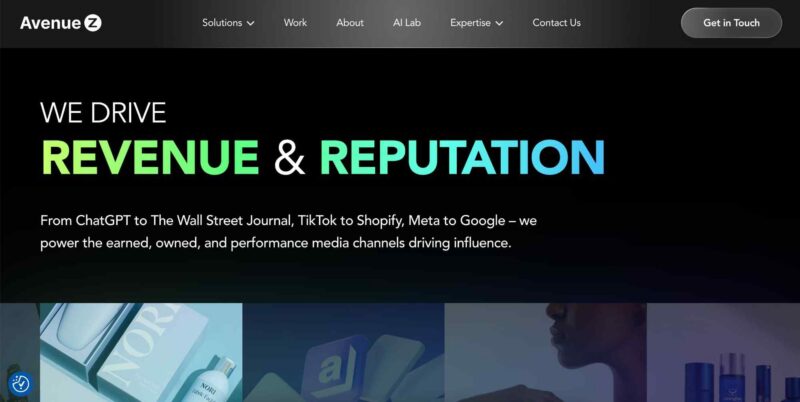
Avenue Z closes the list as one of the more notable newer entrants in GEO. The agency won the 2025 AI Breakthrough Award for Cognitive Communications Solution of the Year and developed AIVx (AI Visibility Index), a proprietary framework designed to measure brand visibility across AI-generated responses. Its approach combines PR, AEO, and communications strategy, creating a model that differs from traditional SEO-led GEO agencies. Avenue Z also maintains strong client feedback on Clutch, with reviewers frequently highlighting industry expertise, strategic guidance, and proactive project management. The primary reason it ranks below higher-positioned agencies is that publicly available GEO outcomes remain largely qualitative, supported by methodology and industry recognition rather than detailed case studies with visibility, traffic, lead, or pipeline metrics.
| Headquarters | New York, NY |
| Clutch | ✅ 4.7 (15 reviews) |
| Notable Clients | Clients in fintech, emerging tech, B2B SaaS, venture capital, healthtech |
| Services | GEO/AEO, Digital PR, Communications Strategy, SEO, Social Media Management, Brand Narrative |
| Best For | Founder-led and VC-backed brands wanting GEO built on earned media and communications |
| Pricing | $50,000–$200,000+ annually depending on scope |
GEO Agency Pricing: What to Expect in 2026
5 Questions to Ask Any GEO Agency Before You Sign
Final Word
See What GEO Can Do for Your Pipeline
Partner with Stratabeat to build AI search visibility that drives qualified leads — not just citations. Let’s TalkFAQs about GEO Agencies
SEO (Search Engine Optimization) focuses on ranking in traditional search engine results pages. GEO (Generative Engine Optimization) focuses on appearing inside AI-generated search results from AI-powered answer engines like ChatGPT, Perplexity, Google’s AI Overviews, Google Gemini, and Claude. The mechanics are fundamentally different: SEO prioritizes keywords, backlinks, and technical structure for crawler-based ranking; GEO prioritizes entity optimization, semantic structure, topical authority, structured data ecosystems, and brand signals that LLMs recognize as trustworthy and citable. Agencies often use the terms AEO and AI SEO interchangeably with GEO — they refer to substantially the same practice.
Timelines vary, but brands typically see citation improvements for long-tail queries within 4–8 weeks of focused optimization. Competitive head terms take longer — usually 3–6 months of sustained effort. Some results, like the Masttro case study above, emerge within four months. Be skeptical of any agency that guarantees specific timelines for AI placements in specific AI responses — the AI search landscape is evolving quickly and no one controls the generative AI model.
No — at least not yet, and not entirely. Traditional search still drives the majority of B2B research traffic. The best-performing brands in 2026 optimize for both: organic search rankings and AI answer visibility. The agencies that understand this treat GEO and SEO as complementary disciplines, not competitors, and build SEO/GEO content strategies that compound across both surfaces.
Serious GEO engagements at the agencies on this list range from $6,000–$25,000+ per month depending on the complexity of your site, competitive landscape, and the scope of services (GEO alone vs. integrated with SEO, content, and CRO). First Page Sage starts at $12,000/month; Stratabeat starts at $6,000/month; RevenueZen is typically $6,500–$9,000/month. Under $5,000/month, it’s difficult to fund the strategy, content creation, and performance measurement that genuine GEO requires. See Stratabeat’s pricing at stratabeat.com/stratabeat-pricing/.
Ask for a case study that shows AI traffic, LLM visibility, or AI-driven leads — not just organic traffic wins rebranded as GEO. Ask who on their team publishes how GEO gets done (not just that they do it). Ask how they measure GEO outcomes and what AI Search analytics tools they use. Agencies that can answer all three questions with specifics are genuine practitioners. Agencies that pivot to generic AI language and can’t show their work are not.
GEO (Generative Engine Optimization), AEO (Answer Engine Optimization), and LLMO (Large Language Model Optimization) all refer to substantially the same practice: optimizing for visibility in AI-generated responses rather than traditional SERP rankings. As of 2026, the terminology debate has largely settled on GEO as the dominant term in the industry, though AI SEO is also used widely. The platforms targeted — ChatGPT Web Search, Perplexity, Google’s AI Overviews, Google Gemini, Claude — are referred to collectively as generative AI models, AI-powered answer engines, or AI search engines depending on the context.
Related Content